
Blinds for Arched & Custom-Shaped Windows
Yes, arched and oddly shaped windows can absolutely get window coverings, but not in the way most people expect. You won’t find roller blinds for arched windows that cover the whole shape and roll up and down like a normal window. What actually works is a combination approach: a fixed covering for the arch itself paired with an operable blind on the rectangular section below. If you’ve been searching for custom blinds for arched windows because a standard size just won’t cut it, that’s exactly the right instinct. Nothing off the shelf is built for these windows, and trying to force a stock size onto an arch or an angled cut almost never ends well.
We get calls about this all the time in Edmonton, especially in older character homes and newer builds with those statement windows above the front door or in a great room. Once you understand the two or three ways this gets solved, the whole thing feels a lot less intimidating.
Why Standard Blinds Don’t Fit Arched Windows
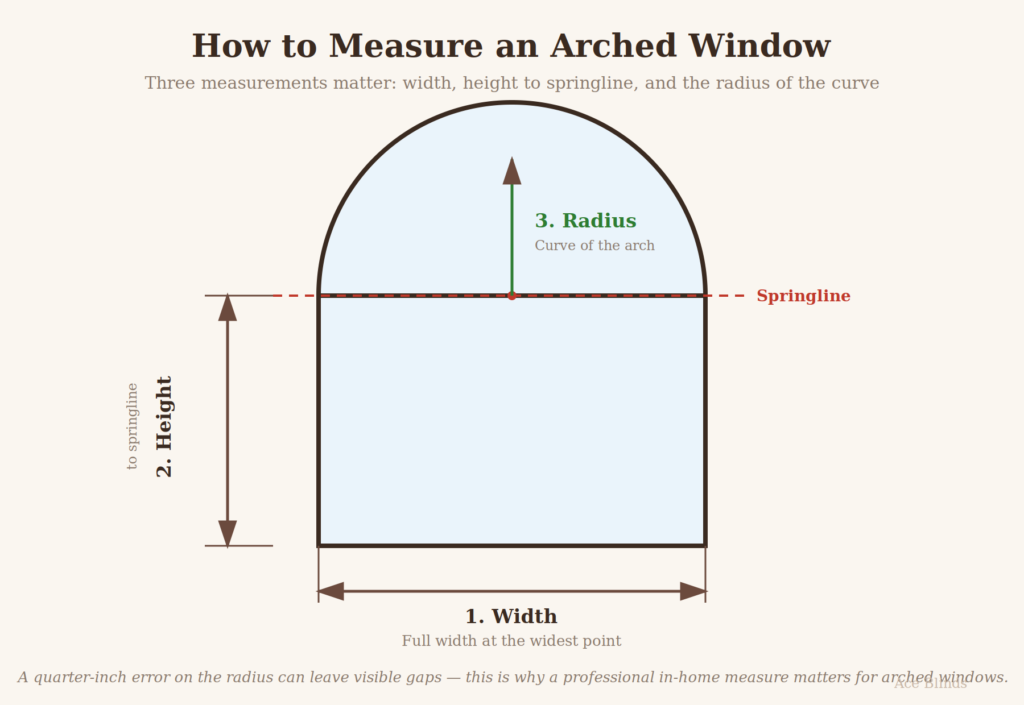
Regular blinds are built on a straight headrail. That headrail needs a flat top edge to mount to and a consistent width to lower into. An arch has neither. The moment you get above the spring line (that’s the point where the arch starts curving away from the rectangle), there’s no straight edge left to attach anything that moves.
This is why so many homeowners end up frustrated after measuring their own window and calling around. A shop tells them the window “can’t be done” when really what they mean is it can’t be done with a standard product line. That’s a different problem, and it’s one we solve constantly.
Fixed vs. Operable Arch Solutions
This is the decision that shapes everything else, so let’s get it straight early.
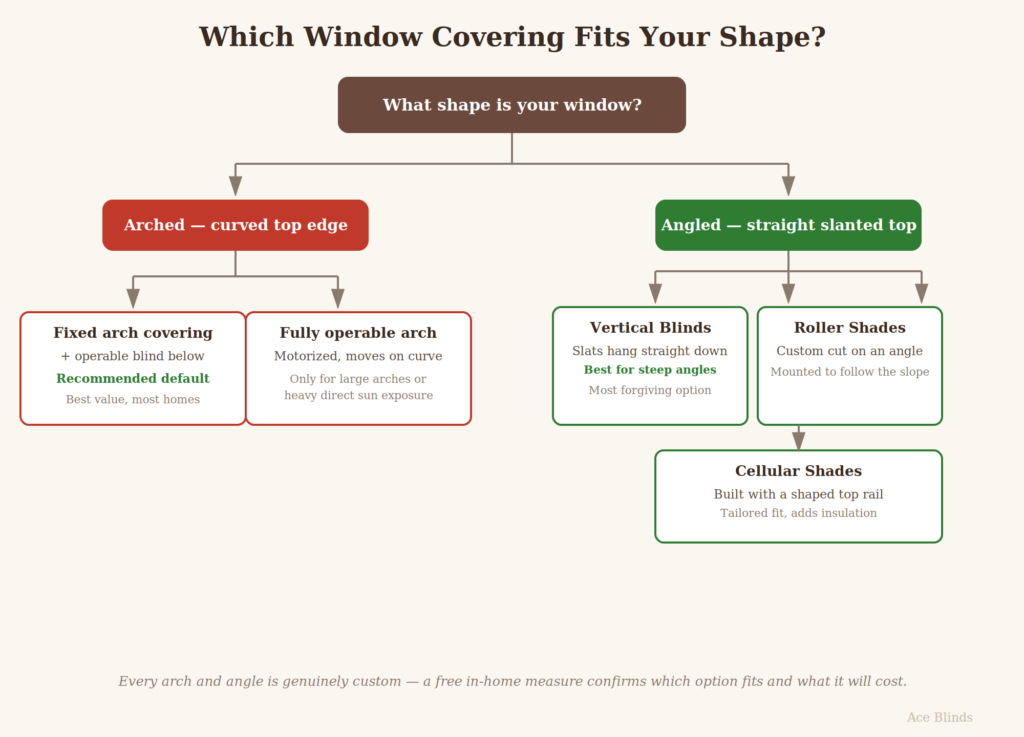
Fixed arch coverings stay in place permanently, shaped to match the exact curve of your window. They’re mounted flush against the arch and don’t open or close. Most people pair these with:
- A faux wood or vinyl fan pattern (sometimes called a fan blind) that follows the curve — see our Roller Shades collection for fabric and color options
- A honeycomb or pleated arch insert for a softer look. Curious about honeycomb specifically? See our full guide to Honeycomb Blinds in Edmonton
- A solid shaped panel if privacy matters more than light
- Prefer a softer, fabric-forward look instead of a shaped panel? We can pair a fixed arch piece with full-length drapery on the rectangular section below — see our Drapery options
Operable arch solutions actually move, but they’re pricier and more mechanically complex. Think motorized arch shades on a curved track, or specialty products designed to retract into the arch shape itself. Honestly, for most homes, this isn’t worth the cost unless the arch window is massive or gets direct afternoon sun that really needs daily adjusting.
Our usual recommendation is a fixed covering on the arch and a fully operable blind below it on the rectangular portion. You get light control where you actually need it and a clean, finished look above.
Roller & Vertical Options for Angled Windows
Angled windows are a different animal from arches. These are windows with a straight but slanted top edge — the kind you’ll find in vaulted ceilings, sunrooms, and A-frame style additions. If you’ve got a vaulted window specifically, the same angled-track logic below applies.
If your A-frame window is fully triangular rather than just angled at the top, the same vertical-blind logic applies — a triangle window doesn’t need a fully custom shape solution the way an arch does, just a headrail cut to match the slope.
Here, window blinds for arched windows logic still applies loosely, but the hardware options open up more. A slanted top can often still take a headrail if it’s cut and angled to match. That means:
- Roller shades custom cut on an angle, mounted to follow the slope
- Vertical blinds hung from an angled track, which handle slants better than horizontal slats do. Explore our Vertical Blinds Collection.
- Cellular shades built with a shaped top rail for a tailored fit
Vertical louvers tend to be the most forgiving option for steep angles because the slats hang straight down regardless of what the top rail is doing. If you’ve got a sharply pitched window and want something that still opens and closes daily, that’s usually where we point clients first.
How Measuring Works for Non-Rectangular Windows
This is the part that trips people up, and honestly it’s the reason we always recommend a professional measure for anything that isn’t a standard rectangle.
For an arch, we need the full width, the height to the springline, and the radius of the curve itself. Get that radius off even slightly and the covering either won’t seat flush or will leave gaps at the edges you’ll notice every single day.
For an angle, we’re measuring both top corners separately since they’re rarely identical, plus the steepest and shallowest points of the slope. A quarter inch of error on a straight window is usually forgivable. On an angled cut, it can mean the whole piece doesn’t sit right.
If you want to try measuring yourself first, use a story pole (a straight piece of wood or a folding ruler) rather than a fabric tape measure. Fabric tape sags on odd angles and throws your numbers off more than people expect.
What It Costs
There’s no flat rate for this kind of work, and honestly, anyone who quotes you a firm number without seeing the window is guessing. The price comes down to a handful of factors:
- The radius and width of the arch. A small decorative arch above a front door is a much smaller job than a floor to ceiling great room window with a dramatic curve.
- Fixed vs. operable. A permanent shaped insert on the arch costs less than anything motorized or built to move.
- Fabric and material choice. Faux wood, vinyl, honeycomb, and pleated fabrics all land in different price tiers, same as they would on a standard window.
- How many angled or arched panels you’re covering. Pricing per window adds up differently on a single feature window versus a whole sunroom of angled glass.
Because every arch and angle is genuinely custom, the only way to get a real number is to have it measured. That’s exactly what a free consultation is for. We’ll walk the window with you, talk through fixed versus operable, and give you a firm quote before anything gets ordered.
FAQ
Can arched windows even get blinds?
Yes. It’s one of the most common questions we hear, and the short answer is always yes, just not with a single moving piece the way a standard window works. A fixed shaped covering on the arch combined with an operable blind below is the standard fix, and it looks intentional rather than like a workaround.
Should I measure my own arched or angled window, or hire a professional?
For a straightforward arch with a simple curve, some people manage a DIY measure with the right tools and a lot of patience. But for anything with a tight radius, an unusual angle, or a window you’re not willing to redo if it’s off, professional measuring is worth it. The margin for error is so much smaller than on a standard window, and a bad measurement on a custom piece usually can’t just be exchanged like a stock size can.
What’s the difference between a fixed arch covering and an operable arch blind, cost-wise?
A fixed arch covering — a shaped panel that stays in place — is the more affordable route and what we recommend for most homes. A fully operable arch blind, built to move on a curved track, costs significantly more because of the specialized hardware involved, and it’s really only worth it if the arch is large or gets strong direct sun that needs adjusting throughout the day. For most Edmonton homes, pairing a fixed arch piece with an operable blind on the rectangle below gives you the light control that actually matters at a fraction of the cost of a fully motorized arch.
Can vaulted or A-frame windows get the same treatment as arched windows?
Not exactly the same, but a related approach. Vaulted and A-frame windows typically have a straight, slanted top edge rather than a curve, which means they can usually still take a headrail if it’s custom-cut to match the angle — arched windows can’t do this at all. Vertical blinds tend to be the most forgiving option for steep vaulted angles since the slats hang straight down regardless of the slope above them.
Quick Takeaways
- Standard blinds can’t mount to a curved or angled top edge, which is why arched windows need custom solutions, not stock sizes
- Fixed arch coverings paired with an operable blind below is the most practical and budget-friendly setup for most homes
- Vertical blinds tend to handle steep angled windows better than horizontal slat options
- Getting the radius or angle measurement right matters far more here than on a standard rectangular window
- Cost depends on the arch size, material, and whether you go fixed or motorized, so a proper measure is the only way to get an accurate number
Got an arch or angle you’re not sure how to tackle? Book a free in-home measure with Ace Blinds and we’ll walk you through exactly what will fit and what it’ll run you, no guesswork required.