
The Short Answer: Sheers Filter Light, Shangri-La Controls It
Sheer curtains give you a soft, glowy look that doesn’t change once it’s up. Sheer shades — like Shangri-La — use the same soft fabric, but with horizontal vanes that tilt open and closed, so you get the look and the control. Neither is wrong; it depends on whether you want a fixed decorative layer or a shade that actually adjusts.
Neither one is “better.” They’re just solving slightly different problems, and which one you want usually comes down to how much control you actually need day to day.
What Are “Sheers,” Exactly? (fabric curtains vs. sheer shades)
“Sheers” gets used pretty loosely, so it helps to separate the two things people usually mean by it.
Sheer drape curtains are fabric panels, lightweight, semi-transparent, hung from a rod or track. They’re the classic option: think airy voile or linen-blend curtains that let daylight wash into a room while blurring the view in and out. They’re purely decorative and functional in the sense that they filter light, but they don’t adjust. Once they’re hung, that’s the look you’ve got.
Sheer shades (which is really what Shangri-La blinds are) take the same sheer fabric concept and turn it into something operable. Instead of a static panel, you get horizontal fabric vanes suspended between two layers of sheer material, and those vanes tilt. So you’re getting the soft, sheer aesthetic, but with an on/off switch for privacy and glare built in.
The confusion happens because both products photograph similarly and both use the word “sheer” in their marketing. But one is fixed drapery and the other is a functional window covering with sheers built into its design.
Shangri-La Explained: The Hybrid Nobody Markets Well (Shangri-La blinds)
Shangri-La blinds are honestly one of the more underrated products in the window covering world, mostly because they’re hard to describe in one sentence. They’re not curtains, not quite a shade, not a standard horizontal blind either. They’re a hybrid.
Picture fabric vanes, similar to what you’d see in a slatted blind, but soft and floating between two sheer layers instead of hard slats. Tilt those vanes open and you get diffused light with a view still intact. Close them and you’ve got full privacy with no gaps or sightlines, which is something sheer curtains alone can’t do.
The appeal really shows up in the details:
- Cordless, motorized, or traditional wand operation, so it fits whatever setup a room needs
- Machine-washable or easy-care fabric options depending on the line
- Works especially well in south-facing rooms or spaces with awkward sightlines, like a window facing a neighbour’s fence
It sits at a higher price point than a basic blind, and that tends to be the sticking point for people comparing it to something like sheer curtains. But the trade-off is real functionality. You’re not just decorating the window, you’re controlling it.
Sheer Drapery vs. Sheer Shades: Pros, Cons, Best Rooms
Here’s where it actually gets practical. Neither option is wrong, but they suit different rooms and different habits.
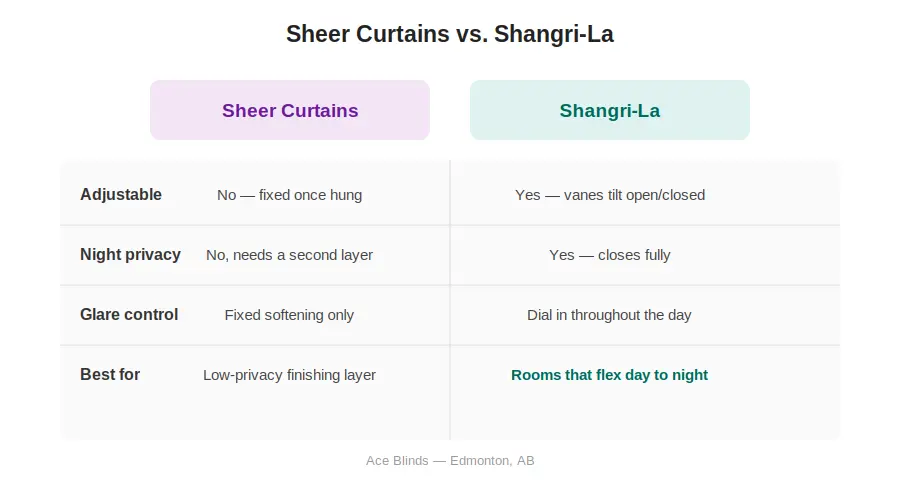
Sheer drape curtains work well when:
- You want a soft, layered look without spending on motorization or hardware
- The room already has blinds or shutters underneath, and the sheers are purely a finishing layer
- You’re going for a relaxed, breezy feel, think a sunroom, a reading nook, or even cafe curtains on a kitchen window where you want light without needing precise privacy control
They fall short when a room needs actual privacy control. A sheer curtain panel doesn’t close, so if you need to block a view at night, you’re relying on something else entirely, usually a second layer like blackout drapes or a liner.
Sheer shades like Shangri-La work well when:
- The room needs to flex between “bright and open” and “fully private” throughout the day, like a home office or a bedroom
- You want the sheer aesthetic but hate compromising on function
- You’re dealing with strong direct sun and want to cut glare without losing all the natural light
They’re a bigger investment upfront, and they’re a shade rather than a curtain, so if you specifically want the fabric-panel, floor-length curtain look, Shangri-La won’t replicate that exactly. It’s softer and more structured than flowing drapery.
Can You Layer Sheers With Blackout for Full Control? (Drapery)
Yes, and this is actually one of the more popular setups for people who want both the look of sheers and full blackout capability.
The idea is simple: sheer drapery (or a sheer shade) handles the daytime, filtering light and softening the room, while a blackout layer behind or in front of it handles the night. Some drapery systems now build this in directly, with individual fabric vanes that rotate between a sheer side and a solid side, so you get both functions in a single track instead of installing two separate treatments.
This layered approach tends to make the most sense in bedrooms, media rooms, or any space where light needs change dramatically from morning to night. It’s more of an investment than sheers alone, but it solves the “I love the look but I also need it dark sometimes” problem that pure sheer curtains can’t.
FAQ
What is the difference between sheers and curtains?
“Curtains” is the general term for any fabric panel hung at a window. “Sheers” refers specifically to lightweight, semi-transparent fabric, so sheer curtains are a type of curtain, just a more delicate, light-filtering one. Not all curtains are sheer, but all sheers are technically curtains.
Are Shangri-La blinds the same as sheer curtains?
Not exactly. They share the sheer fabric look, but Shangri-La blinds are an operable shade with tilting vanes, so they can open, close, and adjust for privacy the way a curtain panel can’t. Sheer curtains stay fixed once hung.
Do sheer curtains provide privacy at night?
Not really, especially once the lights are on inside and it’s dark outside. Sheer fabric is designed to let light through, which means it also lets visibility through both ways at night. Most people pair sheers with a blackout layer or a shade if nighttime privacy matters in that room.
Conclusion
- Sheer curtains are fixed fabric panels that filter light but don’t adjust for privacy
- Shangri-La blinds use the same sheer look with tilting vanes for full light and privacy control
- Sheers alone suit relaxed, low-privacy spaces; Shangri-La suits rooms that need to flex throughout the day
- Layering sheers with a blackout option covers both daytime softness and nighttime privacy
- Neither product beats the other, it comes down to how much control the room actually needs